Level Ground That Foundation Work Actually Requires
Land grading and leveling in Moulton, Athens, Florence, and the greater Northern Alabama area for residential and commercial sites with uneven terrain that must be corrected before construction can proceed
Uneven lots and sloped building sites in Lawrence County and the surrounding area routinely require grading work before any foundation can be set or structure placed. A N Property Professionals handles land grading and leveling in Moulton, Athens, Florence, and the greater Northern Alabama area for both residential and commercial properties, using equipment-driven cut-and-fill methods to bring a site to the elevation and slope the project requires. The owner is on every job, which keeps decision-making on site rather than passed through a crew that wasn't involved in the initial assessment.
The grading process cuts high areas and redistributes material to low spots, working toward the target elevation in passes rather than making one large single cut. Achieving the correct slope isn't only about appearance—finished grade determines the direction surface water travels. When a site is graded so water moves away from the foundation footprint, the building sits on stable, dry ground. When grade runs toward a foundation, moisture accumulates at the base and creates long-term structural problems. Properties in the Moulton, Athens, Florence, and the greater Northern Alabama area with irregular terrain or lots that slope toward where a structure will sit need that drainage direction established during site prep, not corrected afterward.
Arrange a free on-site quote to assess the current elevation of your lot and determine what grading work the project requires.
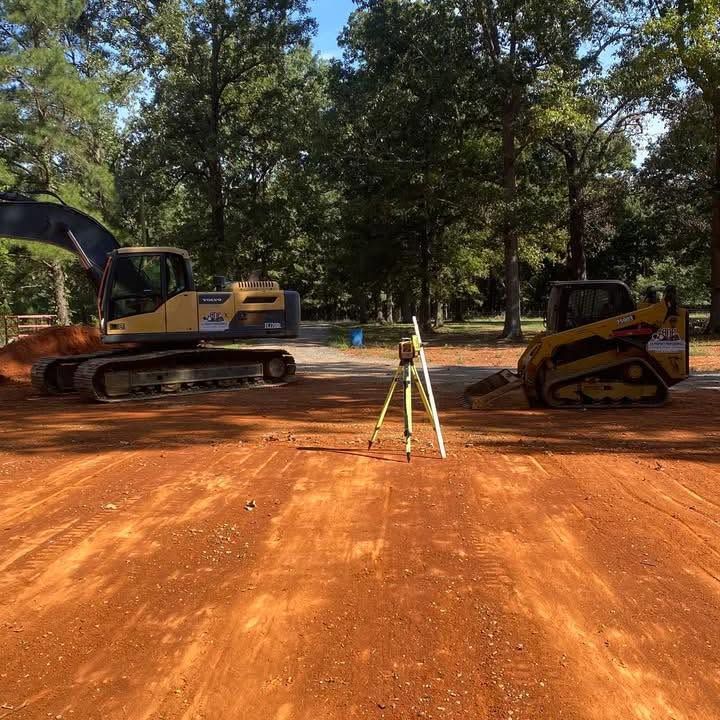
How Cut-and-Fill Grading Brings a Site to Specification
Cut-and-fill grading begins by identifying the target elevation and working outward from there. High areas are cut to grade using a blade or box grader, and that material is moved to fill low areas rather than hauled off the site when fill is needed elsewhere on the same lot. Compaction follows in lifts—loose fill compacted in stages rather than all at once—so settled ground doesn't shift under load after the foundation is poured. The result is a building pad that is stable at the surface and throughout the depth of the disturbed soil layer.
When grading is finished, the changes you'll notice are specific: the lot surface sits at a consistent elevation across the building area, slope visibly directs away from the planned structure footprint, and there are no remaining soft spots or loose material that would compress under foundation weight. A N Property Professionals completes grading work to a finished state, meaning the site is ready for the next construction phase rather than requiring additional passes to reach spec.
Sites that include both a building area and surrounding yard or access paths may require multiple grading passes with different elevation targets for each zone. Those distinctions are established during the initial site evaluation so the finished lot works as a whole rather than as disconnected graded areas.
What Property Owners Ask About Grading and Leveling
These questions address the grading process itself—how decisions are made on site, what the work involves, and what a properly graded lot looks like when the job is done.
What does cut-and-fill grading actually involve on a sloped residential lot?
The crew identifies the target finished elevation, then removes material from high points and compacts it into low areas in measured lifts. The goal is to reach a consistent grade across the building pad without leaving loose or under-compacted fill beneath the surface.
How is the correct slope direction determined before grading begins?
The owner evaluates the lot's existing drainage pattern and the planned location of the foundation, then establishes a slope that directs surface water away from all sides of the building footprint. That determination is made before any cutting starts so the grading plan matches the drainage requirement.
Why does compaction happen in lifts rather than all at once after fill is placed?
Compacting fill in layers—typically six to eight inches at a time—ensures density is consistent throughout the full depth of the disturbed area. Compacting only the surface of a deep fill leaves the lower layers loose, which settles under load and causes differential movement in whatever is built on top.
What conditions on North Alabama-area properties most often require grading before construction?
Lots with natural topographic variation, properties that slope toward the planned building site, and parcels where previous land use has left irregular surface elevations are the most common situations. Hartselle-area properties on hillside lots frequently need significant cut work before a pad can be established.
How do you confirm a graded site is ready for foundation work?
A level, compacted pad with no visible soft spots, correct drainage slope direction, and consistent surface elevation across the building area are the indicators. A contractor or inspector can verify compaction density using a probe or plate compactor test before foundation work begins.
Contact A N Property Professionals to schedule a site visit and free quote—bring the building plan or foundation layout if available so grading targets can be established during the assessment. A N Property Professionals also performs land grading and leveling in Hartselle, Decatur, Athens, Cullman, and Russellville.